
Spinoza
AI and social media increasingly determine what we see, what we believe and what we feel, often without us noticing.
That is exactly why Spinoza’s philosophy is still relevant. He showed how outside impressions can sweep us along, and how we regain clarity by understanding where a thought or feeling comes from.
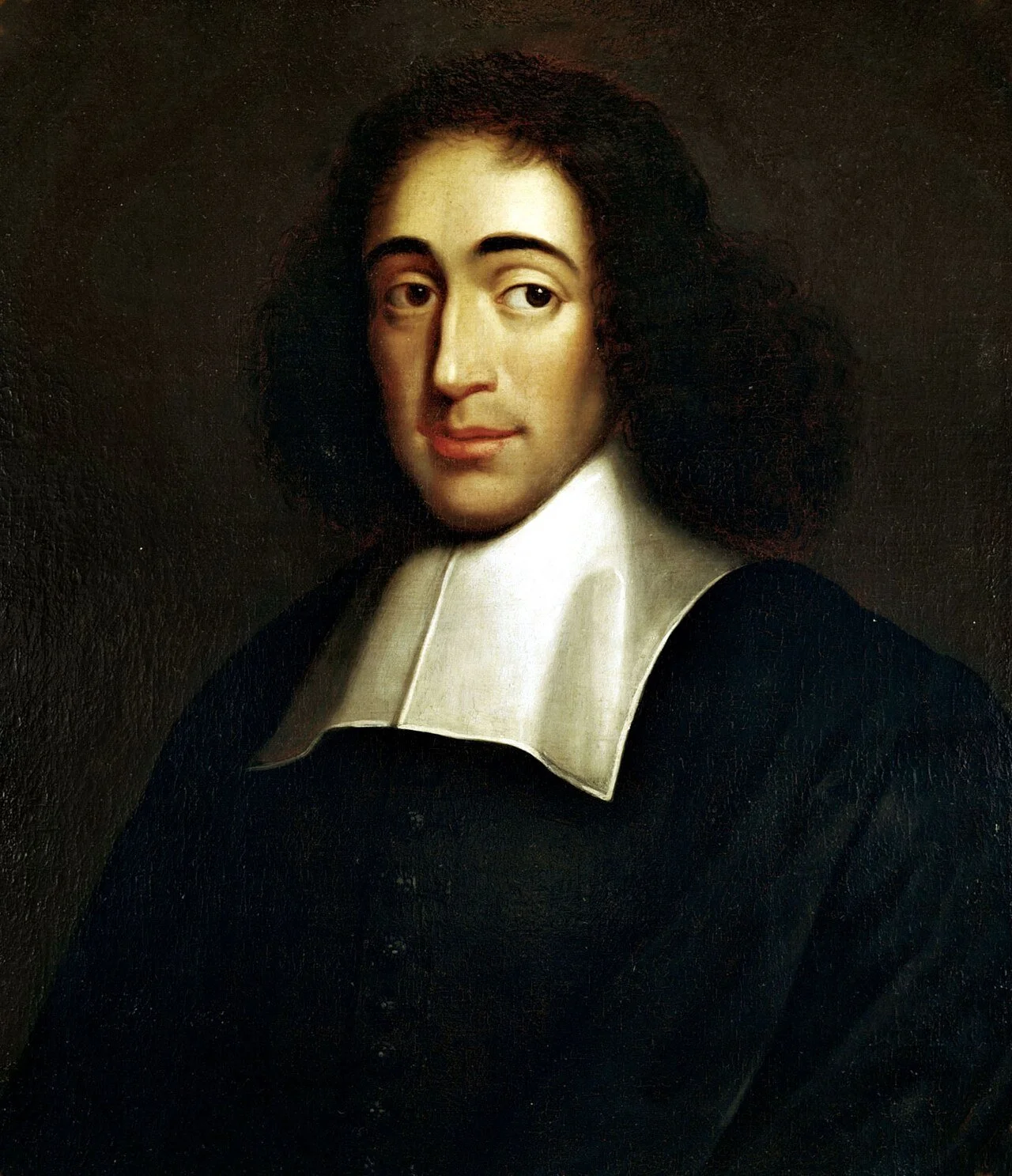
Baruch Spinoza (24 November 1632 – 21 February 1677) was born in Amsterdam into a Portuguese-Jewish family and died in The Hague at the age of 44. His mother died when he was six, after which his father remarried. Spinoza grew up in a strictly Orthodox household and excelled at the Talmud Torah school.
In 1656 he was expelled from the Jewish community because of his freethinking ideas. He lost his place, but remained true to his inner knowing.
His thinking about freedom, self-knowledge and inner strength only grew stronger for it. Perhaps that is the essence of knowing your foundation: not clinging to a place or a group, but to what you know deep inside, even when the world around you doesn’t recognise it.
Three kinds of knowledge
Three kinds of knowledge are central to his philosophy.
The first is imagination (imaginatio): knowledge that arises from sensory experience, memory and the images we form of the world. This knowledge is always incomplete and, according to Spinoza, it is also the source of our mistakes.
The second is reason (ratio): the ability to see common patterns and to understand the causes that connect things. Through reason we move from separate impressions to a whole.
The third is intuitive knowledge (scientia intuitiva): the highest form of knowing, in which we understand how every individual thing follows from Nature itself, and that we are part of something greater. Personally, I compare this to what we now call holistic.
Deus sive Natura
He lived in a time when church and religion shaped people’s thinking and God was seen as someone standing above us. Spinoza saw it differently.
For Spinoza, everything was connected in one nature. It was a progressive and courageous insight: for him, God was not a being above the world. According to him, there is only one substance: God or Nature, Deus sive Natura, infinite and all-encompassing. Everything we see, from a stone to a human being to a thought, is not a separate thing but a manifestation of that one reality.
Three basic movements of feeling
Spinoza’s thinking about feelings also helps us in the present. He speaks of affects. I would rather call them movements of feeling. These movements tell you something about the relationship between yourself and what touches and moves you.
Once you understand where a feeling comes from, you don’t have to suppress it, nor follow it blindly. You can read it like a compass: it shows where you are stuck, where you can become freer, and where your longing for more life makes itself felt. As our understanding grows, we are less governed by passive feelings, the feelings that happen to us because we don’t see through their cause. In this way, we can act more from freedom.
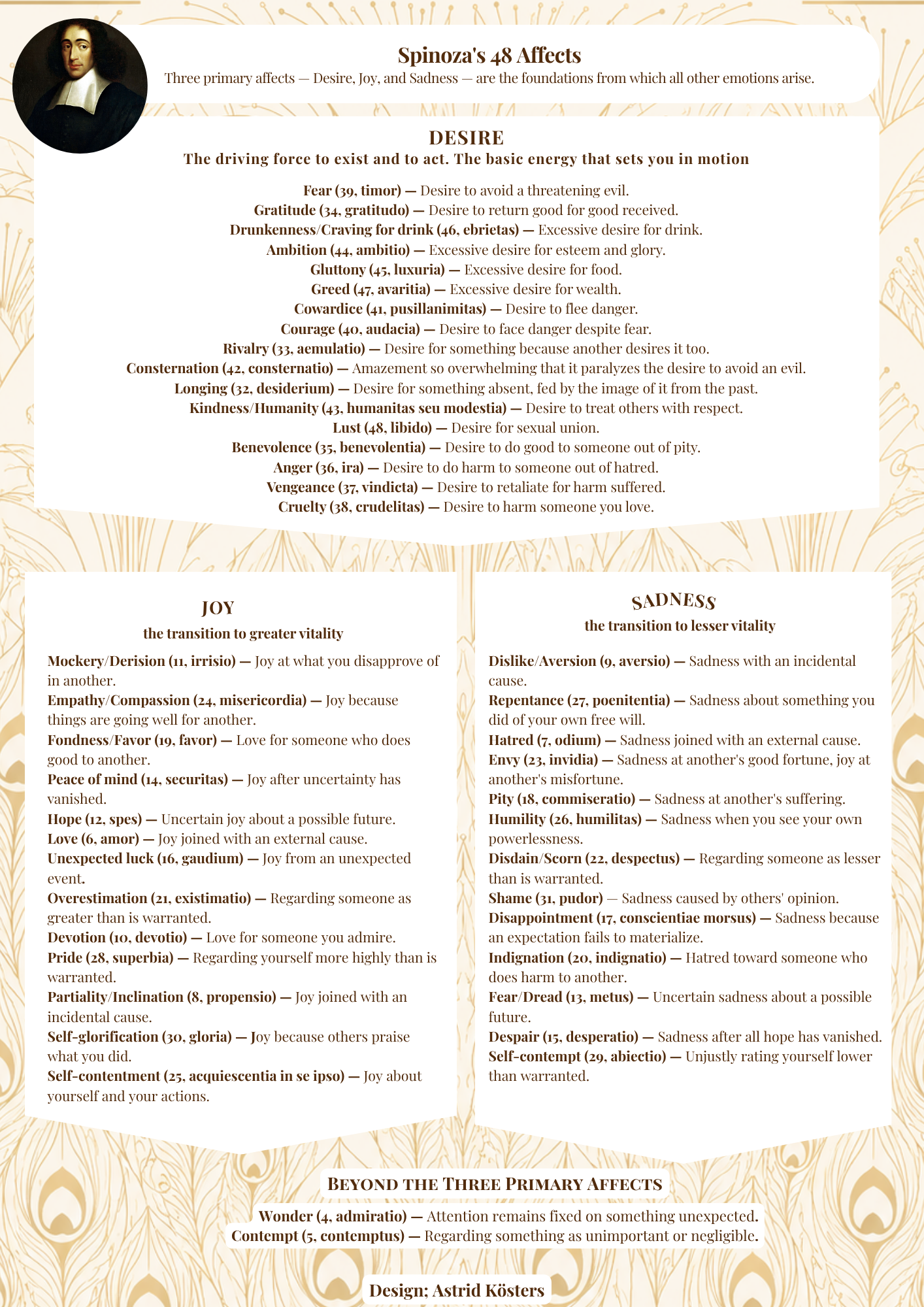
In the Ethics (Part III), he derives all feelings from three basic movements:
Desire (cupiditas) is the human striving to persevere in one’s being and to act according to one’s own nature.
Joy (laetitia) is the transition to a greater power to act.
Sadness (tristitia) is the transition to a lesser power to act.
All other feelings are a variation on, or a combination of, these three. At the end of this part, Spinoza gives 48 definitions of them.
Imperfection
Growth rarely arises from perfect circumstances. More often, it comes from restlessness, or from the need to change. It arises from friction, and from the willingness to get moving and follow your own path.
You can see this path as a form of wisdom. Spinoza did not see perfection as a universal standard, but as the full expression of one’s own nature. Something is perfect when it is fully what it is.
Personally, I see the unfinished as the way there. What seems imperfect is often simply still in motion, not yet complete. The unfinished is not the opposite of perfect, but the road to it.
The unresolved parts of your life are not failures. They are the spaces where something is still becoming.
The 48 Emotions / Driving Forces
Workshops and talks
Through personal sessions or workshops, I help you bring the Compass, the philosophy of Spinoza and the Universal Laws into your daily life, whether you’re at a personal crossroads or guiding a team through change.
Workshops
Saturday 21 November: 10:00 (2 hours)
Sunday 13 December: 10:00 (2 hours)
Wednesday 30 December: 10:00 (2 hours)
Location: Elements of Energy, Nieuwe Kerkstraat 1, Amsterdam.
Regular price €125 / €25 for students
This autumn: introductory rate €75
Private session
Sessions last between 30 and 90 minutes and can take place in my practice, at the shop Elements of Energy, online, or at a location of your choice.
Readings, healings & private sessions: €75 / 45 minutes
Session including energy healing: €100 / 1 hour
10% discount on a package of five 60-minute sessions.